
I don’t start by shooting.
I start by looking for where to stand.
Every stall has multiple angles, but not all of them hold. Some feel right at first—clear view, direct line, everything visible—but they collapse once the movement begins. Hands overlap. Steam blocks the frame. The scene becomes harder to read.
So I move early.
A step to the left. Slightly back. Sometimes closer, but rarely. I’m not looking for the most complete view. I’m looking for the most stable one—the position where the scene doesn’t break apart when it starts repeating.
Once I find it, I stop.
I don’t adjust again unless something forces it.
Staying in one place does more than simplify composition. It lets the scene come to me instead of me chasing it. The stall continues its cycle—orders coming in, plates going out—and from that fixed point, I begin to understand how everything returns to the same positions.
That’s where the structure shows.
Hands move through the same paths. Tools return to the same spots. Even the way the body shifts—leaning in, stepping back—starts to follow a pattern. If I keep moving, I lose that. Every new angle resets the observation.
So I don’t.
I let the repetition build in front of me.
The first few minutes are rarely useful. I’m still adjusting internally—timing, framing, anticipating where things will happen. But after a few cycles, the stall settles into something predictable. Not static, but consistent.
That’s when I start shooting.
One frame at a time, from the same position. The differences are subtle—a hand slightly earlier, a plate slightly off—but they sit within the same structure. The image becomes less about capturing a moment and more about confirming a system.
If something blocks the frame, I don’t step around it immediately.
I wait. Most obstructions are temporary. A person shifts, a tray moves, steam clears. If I’ve chosen the angle correctly, the scene will return to something usable without me needing to intervene.
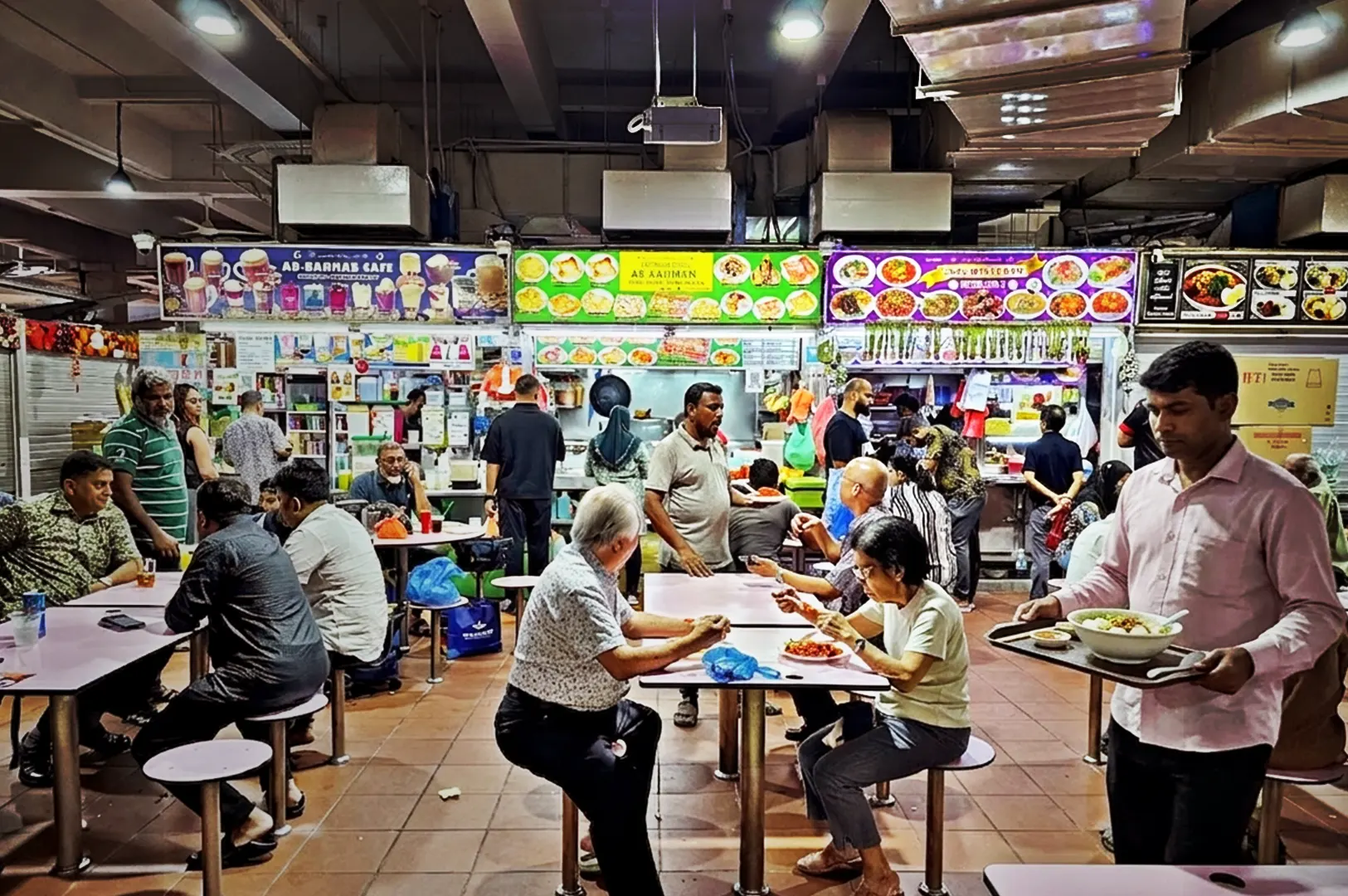
If you follow one position long enough, you start to see how repetition shapes the image. In Circulation and Pause: Tekka Centre Fish Ball Noodles, the rhythm becomes clearer not by moving around it, but by letting it pass through the same frame again and again.
I leave when the angle no longer surprises me.
Not because there’s nothing left to photograph, but because I’ve already seen how it works. And once I understand that, there’s no need to move.